


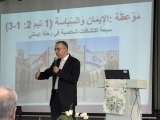
I accepted the Lord Jesus as Savior and Lord, and ever since, I have been attempting to follow him in a land full of wars, racism, and conflict among peoples. In the late 1980s, I did not know how to deal with the Palestinian Intifada as an evangelical who believes in the sovereignty of Jesus Christ and the inspiration of Holy Scripture. Should I join Elijah the Tishbite and protest against the expropriation of innocent people's land, or remain silent before the oppression of Jezebel (1 Kings 21)? The expropriation of land continues, and racism continues to rob our children of their childhood and our land of its joy.
I have faced many wars in my homeland, and I was bewildered regarding my position as a Christian. Should I become a fighter like Joshua, fighting the enemies of God, or resist evil like Jesus, fighting enmity with the love of the cross? Should I carry a stone like David or die as a martyr like Stephen? Should I fight in the name of patriotism, even fighting against followers of Jesus in neighboring countries, or should I fight in the name of religion all forms of killing and bloodshed? I wondered: How do I act when thousands of children are being killed all around me?
I saw many Christians in the world asserting that the Bible speaks about the return of the Jews to Palestine and the formation of a Jewish state in which prophecies will be fulfilled. Whenever I try to answer these questions, some accuse me of being political and argue that focusing on the "salvation of souls" is better than pursuing political and social issues. Yet I am not sure whether the "salvation of souls" means the salvation of the spirit or the salvation of the human being, the world, and humanity as a whole from all sin.
Questions multiplied in my mind: What about military conscription? Does a Christian have the right to serve in the army? What about the sins committed by states when innocent blood is shed and injustice is codified into law? How do we follow Jesus in a world full of politics, whether we like it or not? How do we follow him in a time when wars prevail, injustice, racism, murder, and violence spread, and deep-seated oppression dominates through discriminatory laws? What is my responsibility as a Christian toward the poor and the widows? Should I support laws that promote social justice and care for the marginalized, or does God want me to stay away from everything related to politics and the state? Should I vote in elections, and how do I do that as a Christian?
In my conversations with a number of ministers whom I love and whose opinions I value, I discovered first that I understand the term politics in a different way. Some think that politics means party platforms, partisanship, and factionalism, while others believe that politics is the art of lying and concealing the truth for personal gain. Many evangelical ministers separate politics from faith, so they do not think of God as political or view the heroes of faith as political figures.
Politics is may simply be governmental decisions and the ways to influence them. Do Christians desire to influence state decisions so that they align with the Word of God? Esther was a political figure when she wanted to change the king's decree to slaughter the Jews. Most of the Old Testament prophets wanted to influence governments, so they were political actors. Even God himself speaks about righteous governmental decisions and desires to influence them. God is a politician who is pure from all evil. Look, by way of example and not limitation, at Psalm 2.
Second, I discovered that the question regarding the relationship between faith and politics is uniquely a Christian concern. Our Muslim and Jewish neighbors naturally connect faith and politics. They speak quite clearly about religious states, whether an Islamic state or a Jewish state. Through the lens of faith, they view the entire world, including its social relationships, traditions, and political systems. Thus, we see that the question—Is there a connection between faith and politics?—is a Christian question, not a Muslim or Jewish one. We live in a society that links faith and politics. If we want to engage effectively with this society, we must understand this interconnection and evaluate it through a Christian lens that does not ignore political issues.
Third, I discovered that our question regarding the relationship between faith and politics—or their separation—is a concern held by certain twenty-first-century Christians, rather than a question shared by Christians across all eras or traditions. For example, the Vatican State combines faith and politics, and we find other examples in countries that proclaim Christianity and its traditions as an official state religion, such as Greece. Furthermore, faith and politics were united in the Pentateuch. Moses was both a political figure and a man of faith who called for a theocratic state in which God is the ruler.
We see the pairing of faith and politics throughout all the books of the Old Testament, as the administration of temporal affairs was never separated from eternal matters in the lives of Joseph, David, Solomon, Daniel, Esther, Ezra, Nehemiah, and other Old Testament figures. These individuals were politicians as well as heroes of faith. Faith was also explicitly linked with politics in Christianity from the fourth century onward, when Constantine declared Christianity the religion of the empire. The connection between religion and politics in the form of the state prevailed among Christians around the world until the separation of church and state during the French Revolution and subsequently in the United States.
Fourth, I discovered that the Bible was written within a political context. The Exodus of the people of Israel from Egypt was tied to political circumstances involving the oppression of one nation by another. Diverse political situations appear throughout Scripture: we see wars during the time of Joshua, and we trace the journey of the Israelites through various political systems—at times ruling and at other times displaced and exiled, whether by the Assyrians or the Babylonians.
Moses engaged with politics when he dealt with Pharaoh, and we see the role of politics in the books of Joshua, Judges, Kings, and the Prophets. Then we see it in the life of Jesus Christ, who was born hunted by Herod, became a refugee in Egypt, lived as a displaced person in Nazareth, was tried by the Romans, and was crucified on a religious and political charge—accused of being a king when there is no king but Caesar.
Fifth, I discovered that the Bible does not ask me to refrain from involvement in state affairs. On the contrary, it guides me to engage with the state in a manner that aligns with the mind of the Lord. Scripture commands us to pray for all politicians, stating:
I urge, then, first of all, that petitions, prayers, intercession and thanksgiving be made for all people—2 for kings and all those in authority, that we may live peaceful and quiet lives in all godliness and holiness. 3 This is good, and pleases God our Savior, 4 who wants all people to be saved and to come to a knowledge of the truth (1 Timothy 2:1–4).
These verses demonstrate that followers of Christ are concerned with earthly life, not only life after death. Paul, the Apostle to the Gentiles, desires that we live here and now a peaceful and quiet life in godliness and dignity. He requests prayer for pagan rulers with the aim of blessing Christ’s followers in their earthly lives. He seeks to influence the government and its decisions through prayer, making prayer itself a political act.
This is good and pleasing to God. The Apostle Paul calls us to evaluate what politicians do—giving thanks to God for all that is good, and making intercession for all that is evil. From this, we see that the believer thinks about politics, prays concerning political issues, and evaluates them from a Christian perspective, doing so within the context of the church and worship. Prayer engages both mind and conscience and is built on convictions and obedience to the Lord of the universe. I cannot pray for politicians while simultaneously refraining from sharing a Christian stance on the moral issues with which governments deal.
Sixth, I discovered that the Bible instructs me to submit to the laws of the state. The Apostle Peter writes:
13 Submit yourselves for the Lord’s sake to every human authority: whether to the emperor, as the supreme authority, 14 or to governors, who are sent by him to punish those who do wrong and to commend those who do right. 15 For it is God’s will that by doing good you should silence the ignorant talk of foolish people. 16 Live as free people, but do not use your freedom as a cover-up for evil; live as God’s slaves. 17 Show proper respect to everyone, love the family of believers, fear God, honor the emperor (1 Peter 2:13–17).
Peter connects human structures—governments and political systems—with religious devotion when he says, "Submit yourselves for the Lord’s sake to every human authority." Historically, people accused Christians of rejecting Caesar because they acknowledged Jesus as King. The Book of Acts records this accusation: "They are all defying Caesar’s decrees, saying that there is another king, one called Jesus" (Acts 17:7).
Submitting "for the Lord’s sake" is tied to the role of the state or governor in curbing evil and rewarding good. Peter assumes that the Church acts wisely and does good, challenging foolishness through righteous action. Thus, the Apostle highlights the Church's visible role in doing good and honoring leaders who uphold justice and combat societal evils. Sadly, much of the Church today has lost its role in honoring political leaders who align with God's heart in specific matters. We can summarize the rationale for civic submission as follows: we submit out of respect for divine order, and we submit to silence ignorant criticism.
The Apostle Paul reinforces this perspective:
13 Let everyone be subject to the governing authorities, for there is no authority except that which God has established. The authorities that exist have been established by God. 2 Consequently, whoever rebels against the authority is rebelling against what God has instituted, and those who do so will bring judgment on themselves. 3 For rulers hold no terror for those who do right, but for those who do wrong. Do you want to be free from fear of the one in authority? Then do what is right and you will be commended. 4 For the one in authority is God’s servant for your good. But if you do wrong, be afraid, for rulers do not bear the sword for no reason. They are God’s servants, agents of wrath to bring punishment on the wrongdoer. 5 Therefore, it is necessary to submit to the authorities, not only because of possible punishment but also as a matter of conscience (Romans 13:1–5).
Paul stresses submission to laws and systems that promote fairness and righteousness. Whether one views a governor as a person sent by God (1 Peter 2:14) or notes how Isaiah speaks of the pagan emperor Cyrus as the Lord's anointed (Isaiah 45:1), Paul clearly views the ruler as a servant of God tasked with punishing wrongdoing. The Apostle encourages submission to just authority to avoid legal punishment, honor conscience, and respect divine order. Consequently, this supports paying taxes and fulfilling financial obligations to the state. It is a Christian duty to pay taxes, especially since public funds support infrastructure and serve the poor.
Nevertheless, Paul’s instructions are framed by the priority of love—toward enemies (Romans 12:19–21) and toward believers (Romans 13:8–10). Love replaces vengeance, drives us to overcome evil with good, and fulfills the law. Loving others fulfills commandments against adultery, murder, theft, and covetousness. The question then becomes: How do we actively love the state, rather than merely submit to it?
Seventh, love is inseparable from justice, righteousness, and truth. Therefore, when the state errs, we must challenge evil with good.
When the priests, temple guards, and Sadducees arrested Peter and John for proclaiming faith in Jesus Christ, the authorities commanded them to cease their ministry. The apostles replied that they must obey God rather than human beings (Acts 4:19). Here, religious conviction confronts state overreach. Our responsibility is to serve as light and salt in society, countering evil with the purity of God’s Word.
When a government enacts evil, the Church must assume its prophetic calling. John the Baptist confronted the moral corruption of political leaders, opposing Herod’s marriage to his brother’s wife (Matthew 14:1–5), a stance that cost him his life. Jesus did not sugarcoat things or mince words; he exercised a prophetic ministry. When Herod sought to kill him, Jesus referred to him as a "fox" (Luke 13:32), expressing a clear evaluation of a political ruler. Jesus also confronted the Pharisees—who held both religious and political influence—describing them as whitewashed tombs, clean on the outside but full of impurity within (Matthew 23:27–28). He opposed corrupt power structures, ultimately enduring the cross.
Practical Applications and Recommendations:
• We must understand political issues and connect them to moral values through a Christian lens. If the ruling party promotes abortion, euthanasia, occupation, same-sex marriage, the expropriation of innocent people's land, or an ideology that contradicts human rights and the Word of God, we must speak out and not remain silent in the face of injustice. Let us do as Nathan did when he stood before David—who committed adultery with Bathsheba and then killed her husband Uriah—and let us do as Elijah did when he challenged Ahab and Jezebel, who stole Naboth’s vineyard. Many Christians throughout the ages have acted in this manner; for instance, and by no means exhaustively, Rev. Martin Luther King Jr.
• We must respect and obey the laws of the state, as long as they do not conflict with the Word of God. Thus, we pay taxes and abide by labor laws, traffic regulations, and other laws. However, we should not settle for mere submission, but rise to loving our homeland and striving to build social peace that aligns with the Word of God.
• We must emphasize our social responsibility and good citizenship. We are the conscience of the nation. We are the social salt that preserves the people from corruption, and through the light of Christ within us, we lead the people out of the darkness of hatred, racism, murder, and violence. This is our responsibility and calling.
• Our allegiance to the Church is higher than our national allegiance. We must strive for the unity of the Body of Christ and not fight against one another.
From this, I believe we must engage with political issues without turning the Church into a political party. We must bring our thoughts and stances to prayer and live them out in a way that confirms the Lordship of Christ in everything we do—whether we live among a Muslim majority or a Jewish majority. May the Lord of politics, faith, and all creation preserve you.
 RSS